

Causes of Fibrodysplasia Ossificans Progressiva (FOP)
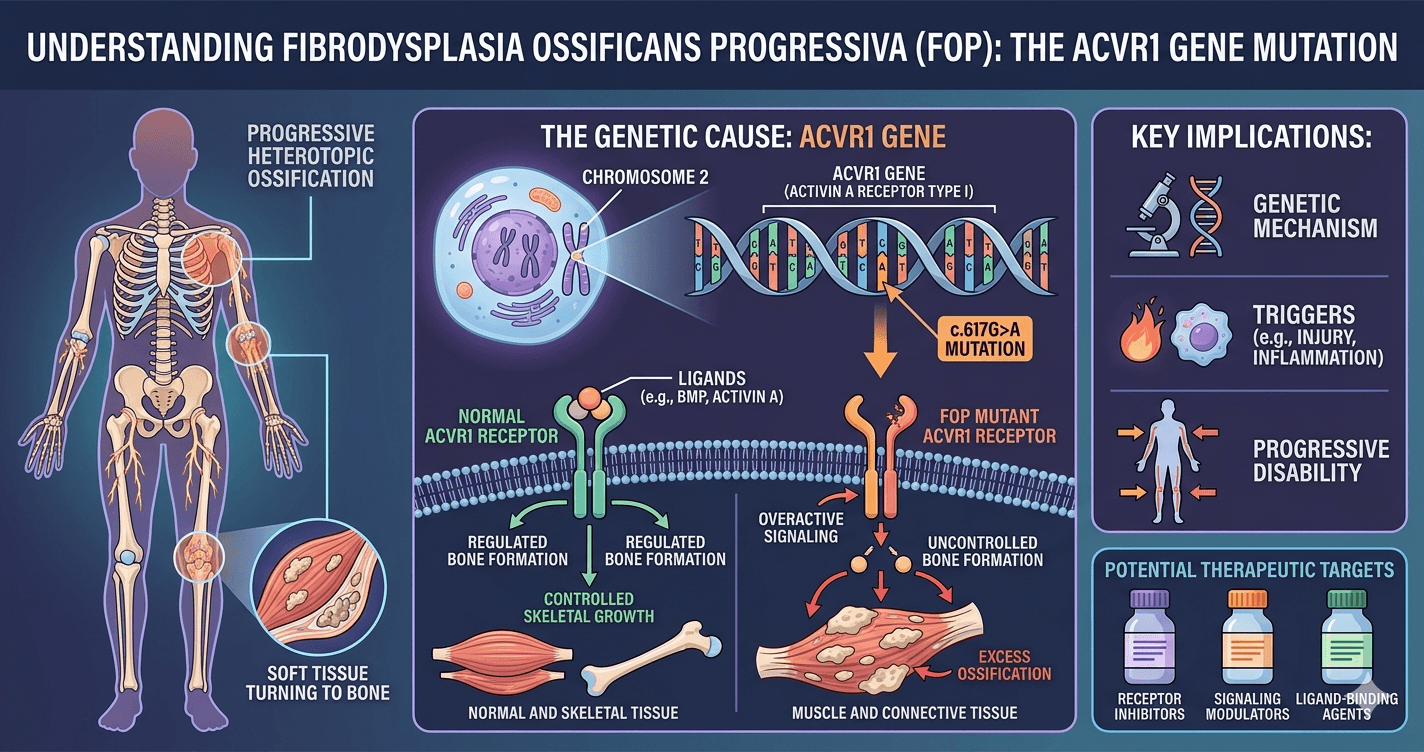
Fibrodysplasia Ossificans Progressiva causes are varient but the main cause is a mutation in the
ACVR1 Gene.
Fibrodysplasia Ossificans Progressiva (FOP) Gene control the function, development and progression of bone by producing protein. Whenever it react overactive that leads excessive formation of bone from muscle ,cartilage, tendon and ligament.As a result, the human body becomes rigid and cannot move easily.
What Happens in FOP?
- The mutated ACVR1 gene becomes overactive
- It sends wrong signals to the body
- Soft tissues such as muscles, tendons, and ligaments gradually turn into bone
Most common mutation: c.617G>A;(R206H)
Inheritance
- Autosomal Dominant Disorder
- Only one defective copy of the gene can cause FOP
- Most cases happen due to a new spontaneous mutation rather than inheritance from parents
Triggers That Worsen the Condition
Although not the main cause, these can trigger extra bone formation:
- injuries
- surgery
- injections
- muscle strain
Fibrodysplasia Ossificans Progressiva Symptoms
Fibrodysplasia Ossificans Progressiva (FOP) is a very rare genetic disorder in which soft tissues (muscles, tendons, ligaments) gradually turn into bone, forming a second “skeleton.”
Symptoms usually start in early childhood and worsen slowly over years due to repeated flare-ups and abnormal bone growth. Symptoms are:
1) Malformation of Toe, the earliest sign of this disease that found in mainly children is malformation of big toe or malformation of shorten toe.
2) Body feels pain a lot during movement. Sometimes it becomes impossible to move the body.
3) progressive specification of neck ,shoulder ,back, chest , limb.
4) Severe pain , soft tissue swelling , joint stiffness , respiratory difficulty , spine rigit.
Commonly Affected Areas
- Neck
- Shoulders
- Back
- Arms and legs
Fibrodysplasia Ossificans Progressiva (FOP) X-ray
What an X-ray Shows in FOP
An X-ray of a person with FOP may show:
- Extra bone formation in muscles and soft tissues
- Abnormal bone bridges between joints
- Progressive fusion of joints
- Deformities of the big toes (present from birth)
This abnormal bone formation is called heterotopic ossification.
Fibrodysplasia Ossificans Progressiva Pathological Condition
What “Pathological Condition” Means
A pathological condition is an abnormal change in body structure or function due to disease.
Pathology of FOP
1. Abnormal Bone Formation
- Soft tissues (muscles, tendons, ligaments) are gradually replaced by bone
- This process is called heterotopic ossification
2. Genetic Abnormality
ACVR1 Gene
- Mutation in ACVR1 gene
- Causes abnormal activation of bone-forming signals
3. Tissue Changes
- Muscle tissue → turns into bone
- Connective tissue → becomes rigid bone structure
- Leads to permanent stiffness
4. Progressive Nature
- Starts in childhood
- Worsens over time
- New bone forms after injuries or inflammation
5. System Affected
- Musculoskeletal system is mainly affected
- Leads to loss of normal movement
FOP is a pathological condition where a genetic mutation causes soft tissues to progressively turn into bone, leading to permanent stiffness and disability.